You’ve seen it—the image shared across screens, passed between friends, sparking laughter and debate:
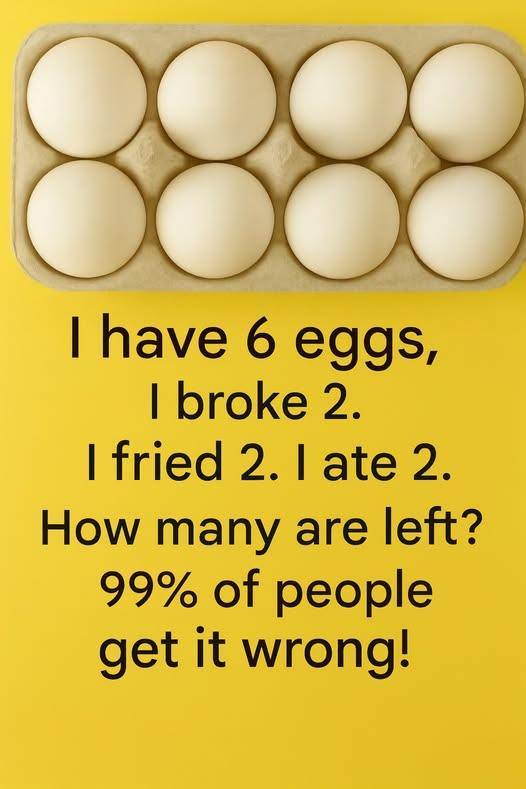
A box. Six eggs. Three sentences.
“I broke 2. I fried 2. I ate 2. How many eggs are left?”
At first glance, it feels like a trick.
But it’s not.
It’s an invitation.
An invitation to notice how quickly we answer—
how often we assume—
how easily we let habit override thought.
Let’s walk through it gently. Not to win, but to wake up.
The Eggs, Unhurried
We begin with six. Whole. Quiet. Whole.
Then:
→ “I broke 2.”
They’re not gone. They’re changed. Still in the bowl—just no longer whole.
→ “I fried 2.”
Not two new eggs. The same two. The broken ones. Now sizzling in the pan.
→ “I ate 2.”
Again—the same two. The broken, the fried, the eaten. One journey. Two eggs.
So how many remain?
Four.
Whole. Unbroken. Waiting.
The math is simple.
The lesson? Profound.
Why We Stumble (And Why It Matters)
Continued on next page:
This isn’t about eggs.
It’s about how we live.
Our minds are trained to move fast—to scan, assume, and answer. In a world of headlines and notifications, slowness feels like loss. But here’s the quiet truth:
Haste isn’t efficiency.
It’s exhaustion wearing the mask of productivity.
This riddle catches us not because it’s clever—but because we’re tired.
Tired of thinking deeply.
Tired of reading fully.
Tired of waiting long enough for the full story to unfold.
And yet—
when we pause,
when we trace the path of those two eggs,
we see:
The rest were never touched.
Beyond the Box: A Practice for Living Well
This little puzzle holds a mirror to our days:
Continued on next page: